An Executive Journal from Outfront Solutions
Issue 2: What Are You Known For?
From the Journal: Building on Last Month
The Architecture of Meaning is not a single idea. It’s an ongoing exploration of how meaning is built – the decisions that shape organizations’ relationships with their audiences and the experiences that determine whether people find those organizations worth remembering.
Last month we asked our readers: Do you know what your organization stands for?
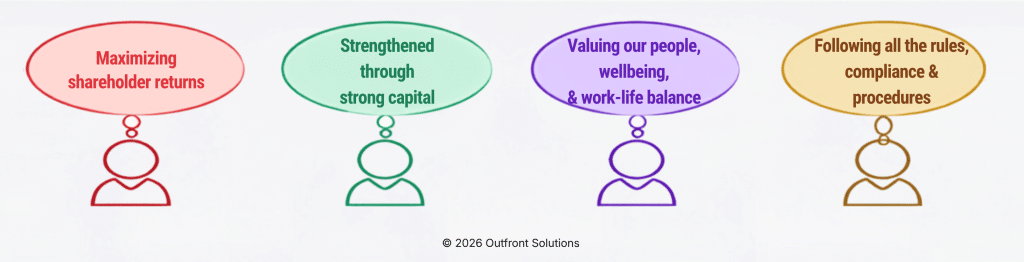
Many of you said yes. That answer stayed with us because it revealed something worth investigating. This is an anomaly. A significant one. We’ve almost never heard two people from the same organization give a consistent answer.
So it needs validation. If you said yes, would others in your organization say the same thing? We invite you to test your hypothesis and let us know the result!
The distance between what you think you stand for and what your customers actually know you for is where this month’s work behind the words begins.
Jeanine Moss & Nicole DeMeo
The Question
What Are You Known For?
Many organizations describe what they hope people will believe, but far fewer have genuinely explored the meaningful role they actually play in their audiences’ lives.
Positioning is not a sentence on your website or a slide in your strategy deck. It’s the set of choices an organization wants to express operationally, consistently, and credibly.
It begins with asking: What do we want to be known for in reality, not aspiration?
Positioning: The First Step in the Quest for Meaning
Positioning is the process of strategically determining what you want to be known for among your audiences and how you will get there.
It’s not a statement. It is a system of promises an organization must be able to live up to.
Purpose clarifies why your organization exists and what it wants to do. Promises translate that purpose into value for its audiences. Together, they establish the role an organization wants to play and what it hopes to become known for.
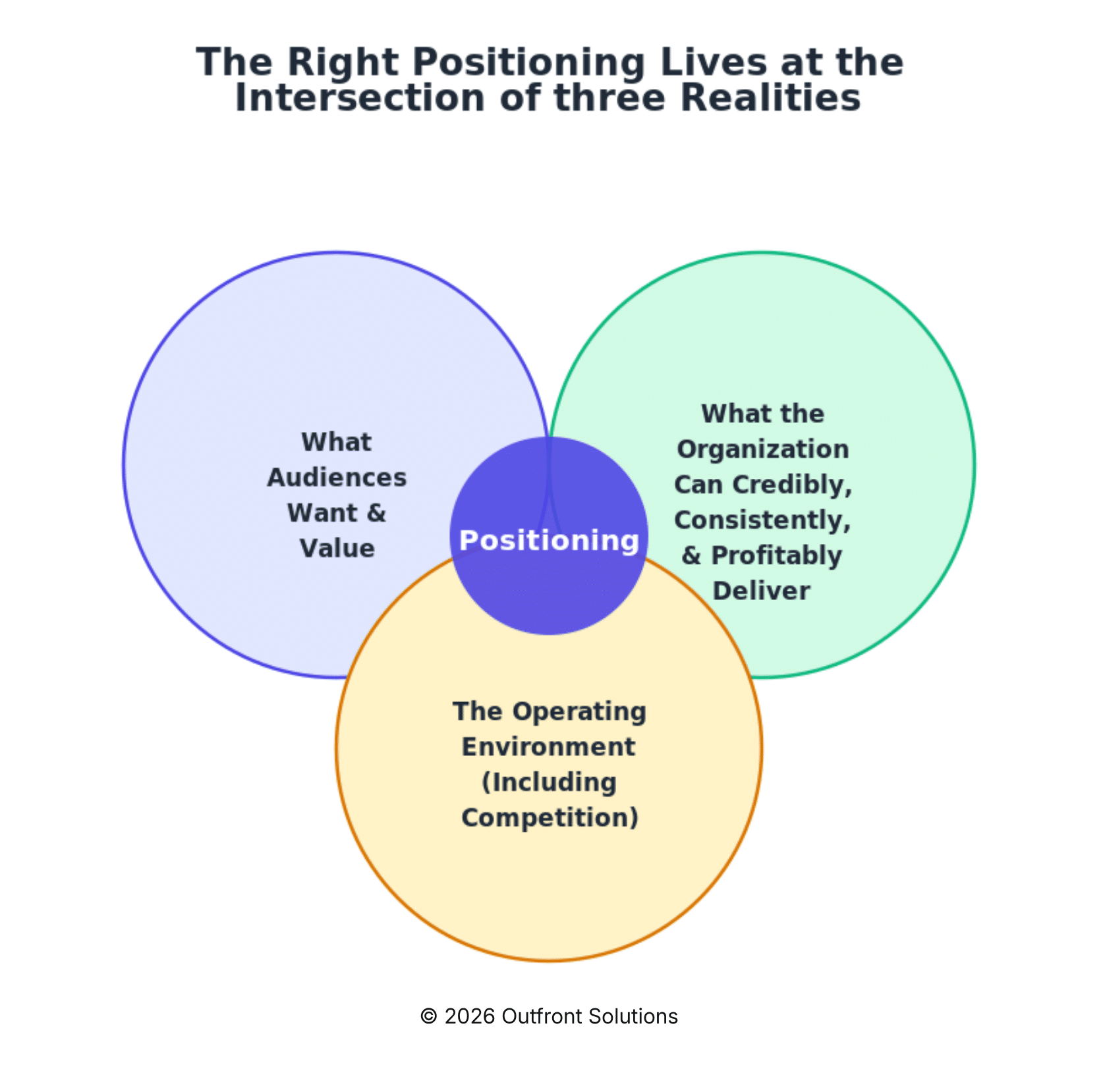
Organizations may wish they could make many promises, but the right positioning offers something audiences genuinely want and the organization can credibly, consistently, and profitably deliver.
The right positioning lives at the intersection of three realities.
• What its audiences value and want
• What the organization can credibly, consistently, and profitably deliver
• The operating environment (including competition).
The World Gets a Vote
Even a position that looks sound inside the organization must survive the world outside it.
That’s why the operating environment matters. Competitive analysis is part of it, but a PESTLE analysis provides critical depth. For example, Politics can support or undermine adoption. Economics affects the pocketbook. Social conditions reflect relevance. Technology is baked into everything. Legal requires compliance. Environment increasingly affects choice.
These forces do more than surround a position. They often dictate what the organization must do to deliver and sustain its promises.
This is why positioning is hard. It asks an organization to align purpose, promises, audience needs, operations, competition, and a changing environment without losing the clarity that makes the organization distinct.
Research Reduces Risk. Customers Reveal Meaning.
Who doesn’t want to make a hit movie, publish a viral post, or write a bestselling book? Millions are spent trying to predict what people will embrace. But if there were a consistent formula, we would have nothing but blockbusters and millions of followers.
There are useful ways to understand audience receptivity before committing resources: quantitative and qualitative research, testing ads, beta versions, and firsthand experience. None of this guarantees understanding, relevance, or adoption.
The most revealing test happens in real life, at the ballot box or the checkout counter. Surveys may show universal appeal, yet launch day often reveals the truth. CNN+ is a stark reminder; despite measuring streaming growth and the strength of its brand, CNN failed to establish that people wanted another standalone subscription.
After testing with audiences, organizations must roll out, observe, and learn. Only then do you discover whether your positioning is resonating and how audiences are evolving it.
When Customers Change the Meaning
When audiences interpret your meaning differently from the way you defined it, it should trigger diagnosis, not defensiveness.
Most often, a gap points to an alignment problem between promise and experience, communications, or to an unmet customer need.
New meanings must be evaluated with the same rigor as your original positioning. Can your organization credibly deliver it? Is it shared by enough of your target audience to be extensible? Does it align with your intended destination?
Listening to customers means treating experienced meaning as strategic evidence, not chasing every reaction.
In Practice
Apple: True to Its Core
by Nicole DeMeo
The Architecture of Human Possibility
When I worked at NeXT and then Apple during the “Think different” era, I learned that Steve Jobs’ genius wasn’t technology. It was alignment.
Steve understood what people wanted and needed. He didn’t just make products. He made meaning.
What struck me most was that Apple’s core position never wavered, even as products and markets shifted. Apple started with a clear Architecture: a purpose to expand human possibility by challenging convention; a promise that powerful technology could feel intuitive, personal, and human; positioning at the intersection of technology and the arts.
People weren’t buying processor speed. They were buying possibility, creativity, simplicity, and belonging to the future. When audiences revealed what mattered, Apple stayed aligned. It simplified technology, elevated user capability, and expanded meaning into privacy and accessibility – new dimensions rooted in the same belief. Apple was rarely the hero. Its customers were.
That Architecture guided everything – products, messaging, packaging, retail, keynotes.
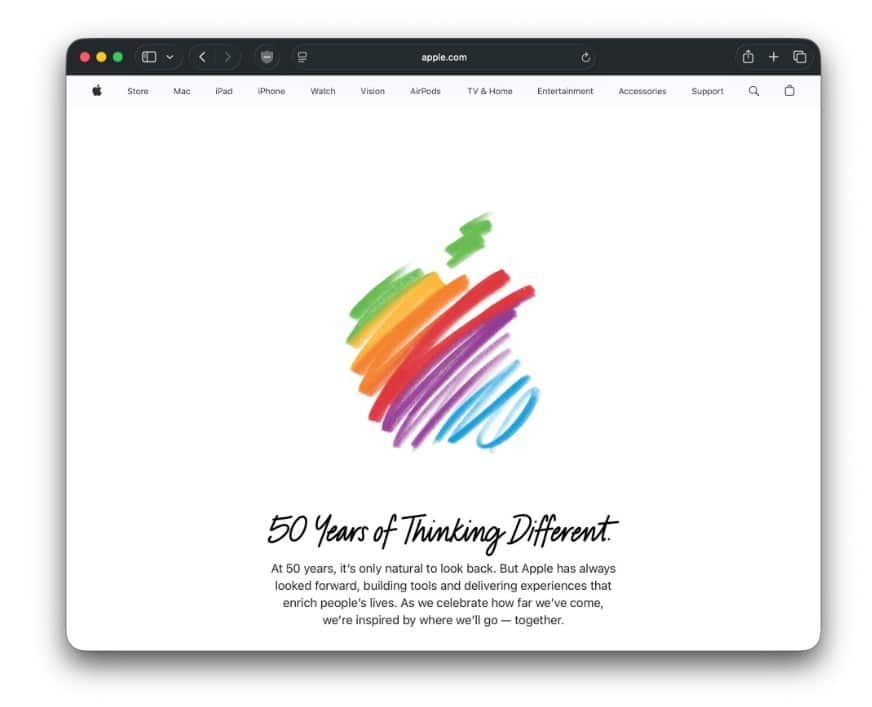
This is how position evolves: the core stays steady while expression grows as needs reveal new ways to matter. Apple’s “50 Years of Thinking different” campaign proves it. Fifty years of impact become evidence that the central belief still holds. That’s the Architecture of something that lasts.
Read: What Steve Jobs Taught Me →
The Outfront Method
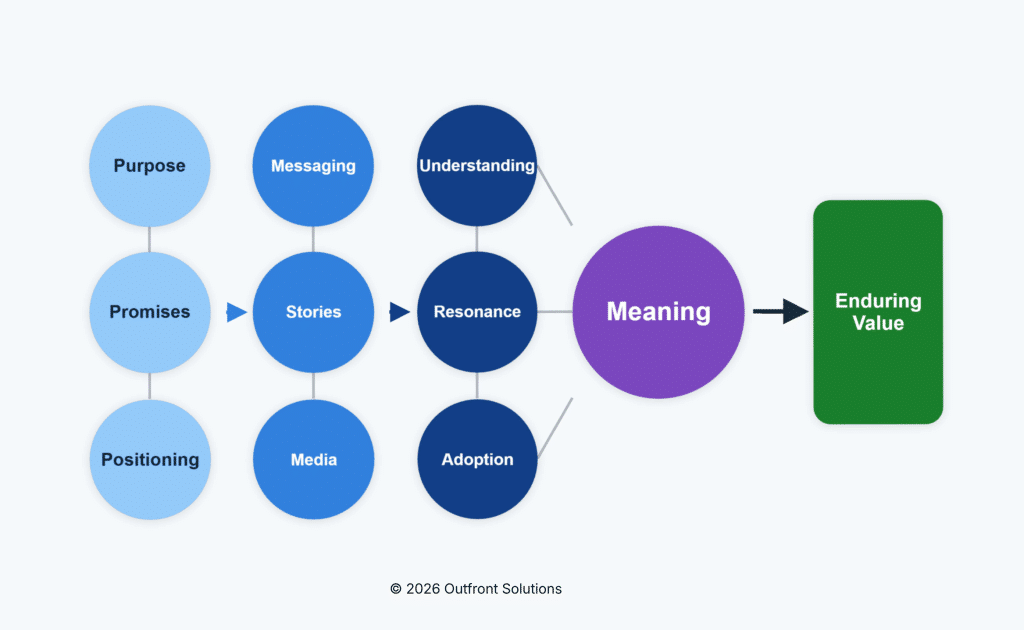
The Architecture of Meaning is our philosophy. The Outfront Method is how we apply it.
Positioning is where organizational truth, authentic promises, customer reality, and the operating environment meet. It focuses on the meaning an organization wants to earn before messaging gives that meaning language.
From there, every experience becomes evidence. When promises and experiences align, audiences can understand the organization, find it meaningful, remember it, and choose it.
(August Offer) Brand Readiness Architecture
A strategic framework instantly deployable across every channel.
Leadership vision and strategy shouldn’t live in the conference room. Translating that vision into a narrative that teams, stakeholders, and markets can understand, align with, and advance is where most leaders get stuck.
We bring leaders and implementation teams together in a workshop to create a differentiated market-ready position based on purpose, promises and today’s operating environment. You get a decisive articulation of your strategy that moves from ambition to action and can immediately be implemented on websites, newsletters, presentations and more.
Schedule a complimentary consultation →
Closing Thought
Positioning begins by deciding what you want to mean. It becomes real when the audience can say it back.

Be understood, meaningful, and chosen.
Editor & Author: Jeanine Moss
About Outfront Solutions
Outfront Solutions helps bold leaders and brands become meaningful and chosen by building relationships with the people they serve. We architect strategy and storytelling, orchestrate communications systems, and transform understanding into relevance, adoption, sustainable growth and enduring value.